How to share a vacation home with family: five ways to split the calendar
By Dan·Published

Short answer
There are five common ways to split a shared vacation home: fixed weeks, a rotation, a draft, booking as you go with limits, or matching everyone's preferences. Decide which one fits your group, how holidays work, and what happens to nights nobody uses. Then write it down where everyone can see it.
Sharing a vacation home with family often starts out simple. Everyone knows when they like to go, and someone keeps track. Then the family grows, a second and third household want the same summer weeks, and it gets harder to agree on who gets which dates by phone. The same is true for friends who bought a place together.
There is no single right way to divide the calendar. There are a handful of common ways, and each one suits a different kind of group. This guide walks through five of them, the questions every family has to answer whichever one it picks, and a worked example.
First, agree on who is sharing
Before you talk about dates, agree on who the calendar is divided between. A simple way to start is to share by group: one group per sibling, per branch of the family, or per household. Individual people book inside their group's time.
Getting this right first makes everything else easier. "Three groups get equal time" is a clear starting point. "Everyone gets a fair amount" is not. If you inherited the house with your brothers and sisters, our guide to inheriting a vacation home with siblings covers the questions to settle first.
The five ways to split the calendar
1. Fixed weeks
Each group gets the same weeks every year. For example, the Murphys always have the second week of July, and the Lees always have the last week of August.
- Good for: families who like predictability and plan around school calendars and work leave.
- Watch for: the best weeks never move. A group that is stuck with early June every year may stop feeling like the arrangement is shared.
2. Take turns in a rotation
Each group gets a block of time in a repeating order, and the order shifts each year. If Group 1 had the first July week this year, Group 2 has it next year.
- Good for: spreading the most wanted weeks around over several years.
- Watch for: a rotation needs a written record of whose turn is next. Memory is not a record.
3. Draft your dates
Groups take turns picking the nights or weeks they want, one pick at a time, in an agreed order. The order can reverse or rotate each round so the group that picks last in one round picks first in the next.
- Good for: groups whose plans change from year to year, and who want a say in their dates rather than a fixed slot.
- Watch for: a draft takes coordination. Everyone has to be available to pick, or you need a rule for what happens when someone does not.
4. Book as you go, with limits
Anyone can book open nights, first come first served, with limits that leave room for everyone. Common limits are a maximum number of nights per booking, a maximum number of peak weeks per group, or a cap on how far ahead someone can book.
- Good for: smaller groups, houses that are often empty, and families who decide trips at short notice.
- Watch for: without limits, the most organized person tends to get the best dates.
5. Match everyone's preferences
Each group rates the dates it wants, and the schedule is built by balancing everyone's shares, preferences, and flexibility. Some families do this by hand at a meeting. Others use a scheduling tool that builds the schedule from the ratings members enter.
- Good for: groups where several households want overlapping dates and want to see their preferences taken into account.
- Watch for: everyone needs to rate their dates before the schedule is built, and the group still decides the rules the schedule follows.
Whichever you pick, keep the plan alive
A new job, a bad knee, or a change in school dates can make a week that worked in January impossible by June. Expect the plan to change throughout the year. A cancellation does not mean someone has let the family down.
Keep the current plan somewhere every household can see it any day. It should show whose turn is next and record swaps and released weeks, so one person does not have to remember everything. Agree how a change gets confirmed and recorded in minutes, rather than starting another round of group texts. A written plan helps only if it stays current.
Side by side
| Approach | How dates are chosen | Best fit | Main thing to agree |
|---|---|---|---|
| Fixed weeks | Same weeks every year | Predictable plans | Who gets which weeks |
| Take turns | Repeating order that shifts yearly | Sharing peak weeks over time | The order and block length |
| Draft | Groups pick one at a time | Plans that change yearly | Pick order and missed picks |
| Book as you go | Open booking with limits | Small groups, short notice | The limits |
| Match preferences | Ratings balanced into a schedule | Overlapping wants | Shares and when to rate |
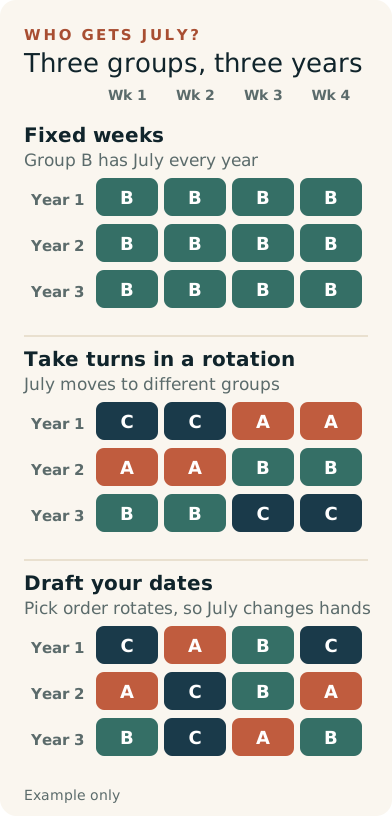 Example: who gets the four July weeks under three of the approaches, if each group has four summer weeks a year.
You can also mix these. One combination is a rotation for summer weeks and booking as you go for the rest of the year.
Three questions every family has to answer
Whichever approach you pick, the same three questions come up. Answer them early.
How long is a turn or a pick, and what day does it start? A week that runs Saturday to Saturday is simple to plan around. Mixing Saturday and Sunday starts causes overlaps.
How do holidays work? The Fourth of July, Thanksgiving, and the week between Christmas and New Year are often the most wanted dates. Families tend to choose one of four answers: holidays are treated like any other day, each holiday passes to the next group every year, holidays count for more of a group's share, or holidays are for everyone. Our guide to sharing the Fourth of July and other holidays has rotation examples you can copy.
What happens to nights nobody uses? Some nights will go unused because people get sick, children get busy, or a trip falls through. Nobody did anything wrong. Agree how an open night reaches someone who wants it. A simple rule is a release date: if a group has not booked its time a set number of days before, anyone can book it. Some families also keep weeknights open to everyone all year. See when one family never uses the house for more on this.
How to bring it up
Try: "I'd love us to have a plan we can all look up and change when life gets in the way. Which dates matter most to each household, and what would make the rest easier?"
Try to avoid: "The calendar isn't fair, and we need to fix it."
If the same dates keep causing trouble, ask what makes them important before changing the rules.
| What makes dates difficult | What might help |
|---|---|
| School or work leaves only a few possible weeks | Gather those constraints before choosing dates |
| A long journey makes short visits impractical | Offer longer blocks where the group can agree |
| A household cannot commit far ahead | Keep some time available for later booking |
| A holiday has particular family meaning | Ask what people want to preserve before proposing a rotation |
A worked example
This example is hypothetical. It shows how one set of answers fits together.
Three sibling groups share a lake house. They want the twelve summer weeks split evenly and the holidays to move around.
- Approach: take turns. Each group gets four one-week blocks, Saturday to Saturday, in a repeating order. The order shifts by one group each year.
- Holidays: the Fourth of July week passes to the next group every year. It counts as one of that group's four weeks.
- Open nights: if a group has not booked its week 14 days before it starts, anyone can book it. Weeknights outside the summer are open to everyone.
- Record: the order, this year's weeks, and the holiday rotation are written down in one place every group can see.
In year one, Group 1 cannot use a week in late July. Fourteen days before, nobody from Group 1 has booked it, so it opens up, and Group 2 books it. The rule was agreed in advance, so nobody had to make a decision that day.
Write it down
The approach matters less than having one that everyone has agreed to and can look up. A written plan answers "whose turn is it?" without anyone having to remember. Pair it with a short set of family cabin rules so every stay works the same way, whoever is there.
If you want a starting point, the free Shared House Playbook walks a family through these decisions one question at a time and turns the answers into a written house plan you can share before you agree on it.
Frequently asked questions
What is the simplest way to share a vacation home with family? For two or three groups, a rotation of equal blocks with a release date for unused time is the simplest to explain and keep track of.
How do you split summer weeks fairly? Agree on the share each group gets first, then pick a method that moves the most wanted weeks around over time, such as a rotation or a draft with a rotating pick order. Fairness here means a rule everyone agreed to, applied the same way every year.
Should the person who uses the house most pay more? Some families split costs equally and some add a nightly fee for using the house. That is a separate decision from the calendar. Agree on it at the same time and keep the two decisions separate.
Related guides
Splitting the calendar
When one family never uses the vacation home
What to do when one household in a shared vacation home rarely or never comes: how to talk about it and how unused time can reach someone else.
By Dan·
Splitting the calendar
Who gets the Fourth of July? A holiday rotation for a shared vacation home
How families share holiday weeks at a vacation home, with rotation examples for three and four groups you can copy.
By Dan·

Rules and agreements
Shared vacation home agreement: how to set calendar rules
Write the calendar part of your shared vacation home plan: turns, holidays, unused nights, changes, and who keeps the current schedule.
By Dan·